 Iker Aguirre
Understanding Values
Values. Everyone talks about them. Inspiration, engagement, company culture… Some words we all use feel self-evident. […]
Values. Everyone talks about them. Inspiration, engagement, company culture…
Some words we all use feel self-evident. We know they matter. We can see why. But when it's time to define them, we come up empty.
Values are a perfect example.
We all have them. We can name them: commitment, transparency, honor, hard work, family, courage… There's something for everyone.
At some point, we've all used the word. We've defended our values. Often, we've worn them like a badge. And if you're a leader building something with people, or protecting a company culture, you can't skip over them.
But there's a problem.
We talk about values. Do we actually know what they are?
Try this in your head. Answer these very simple questions.
What is a value?
How is it born?
Where does it come from?
Why is it so powerful?
Four simple questions, right?
Not really.
And that's exactly why this matters. How can you lead and put people back at the center of your company and your projects if values are still a mystery to you?
If this sounds familiar, you're in the right place. What follows will finally bring real clarity to the whole topic.
By the end of this article, you won't lead the same way.
Where values come from: the roots of personal values and why they matter
Values are reference points. They run deep, and they show up as convictions. Each of us uses them to define, in our own way, what it means to be human with full dignity. And they can never be separated from the social world a person lives in.
But did you know they come from something even bigger and more powerful?
Social archetypes.
A social archetype is a value a society has accepted for a long time, at least a century. It sets the codes of behavior considered acceptable for living in harmony within that society. It also shapes the world as we understand it.
Take the Judeo-Christian archetype, which is widespread in the West. It requires monogamy. Try telling someone at a backyard barbecue that you have five wives or seven husbands. Watch their face! You've broken the dominant archetype. And by doing that, you've placed yourself outside the “norm.”
The thing is, the norm is highly subjective. It's built from history, culture, religion, and the social world around us.
Social archetypes shape how you understand the world. So they also govern the codes of behavior. Put another way: our values flow from social archetypes.
Let's stay with the Judeo-Christian archetype. It puts special weight on the value of family. Seen through that lens, family means monogamous, heterosexual, and built on a lifelong marriage. That's one interpretation of “family,” and it's made of beliefs. Here, subjectivity goes up a notch. We slowly move away from social influence and into a more and more personal space. Beliefs vary from one person to the next. They depend on your story, your upbringing, and the environment you live in or grew up in.
But that's not all. Archetypes lead to values, and values lead to beliefs. And the chain keeps going!

Once beliefs take root, they shape attitudes. An attitude is a way of behaving that reflects a state of mind.
Let's stick with the Judeo-Christian archetype. Picture a casual lunch conversation among a few coworkers. One of them brags about cheating on his wife. His colleague, a passionate defender of family values, gives him a look of contempt. The words shocked him. They collided with his beliefs.
And when an attitude gets seriously challenged… it turns into behavior!
Back to our example. The man is so offended by what he hears that he stands up mid-meal, slams down his fork, and storms out of the restaurant, telling off the self-styled Casanova on his way out.
Later, the friends or coworkers who saw the scene tell him: “You need to keep it together. You went too far. He didn't do anything to you! You need to work on your behavior!”
How many times have we said that to a colleague or an employee? “You need to work on your behavior!”
Easy to say. Not always easy to do…
And there's a reason for that…
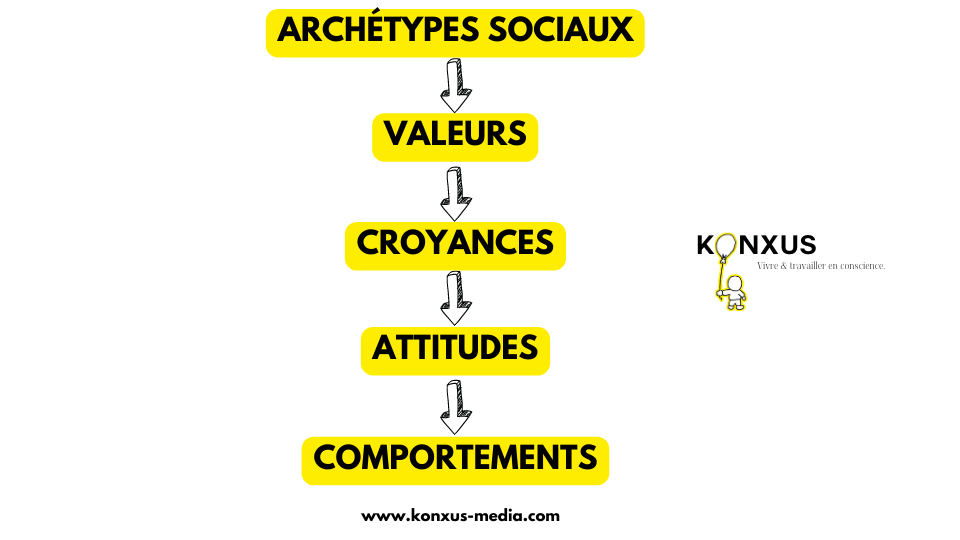
The coercive chain behind personal values
Let's recap…
Archetypes give rise to values. Values generate beliefs. Beliefs turn into attitudes. And attitudes end up as behaviors.
This chain doesn't run on goodwill. It's highly coercive. In other words, archetypes tell values: “You'd better respect us, or else…” And those aren't empty threats. Then values do the same to the next level down, and so on. We know people don't like change. But if you challenge the world as someone understands it, don't expect anything good! Any threat to “their world” is a threat to their territory and their survival. They know nothing else, so the threat promises only destruction, with no alternative. And that void is a kind of uncertainty the brain hates. So people defend their turf tooth and nail. Some would rather let themselves die than face a change in their archetypes.
Nobody gives all that up willingly!
Questioning the impact of your values and archetypes is a demanding path of self-awareness. It's how you discover the real human being behind them. Every leader who wants to put people back at the center should take that path and look beyond their own conditioning. But can they expect their teams to do the same?
Modern leadership: embracing values to transform behavior
Any order to “change your behavior” is likely to fall flat. And that's before you count everything else involved. These expectations don't just touch the framework we're exploring today. They pull in plenty of other psychological levers, too!
Bottom line… we're not out of the woods yet!
On top of that, it's easy to say “every leader should…” Actually following through is another story. So how do you do it?

Living your values beyond the usual dusty exercises
There's nothing new about values. We've always talked about them. What needs to change is how we use them. What I call the dusty exercise is the corporate retreat or team-building offsite where the company defines its values. It becomes a sacred moment. Posters get printed. Beautiful frames go up on every wall. And that's it.
Time goes by. The frames gather dust. Nobody remembers what they mean anymore. Nice words, nothing more…
I once helped a large company define its values. We involved the entire workforce, nearly 1,000 people. It took several weeks to land on something that deeply resonated with everyone. The final presentation was a beautiful moment. When we finished, you could feel the pride of belonging in the room. We had done powerful work on identity. That's when I turned to the wall, pointed at a frame, and asked:
“What do we do with this?”
The frame read: “Our Group Values…”
Not a single one showed up in the work we had just done.
That dusty frame was full of empty words nobody knew and nobody lived by. It came down fast and was replaced.
What matters with values isn't displaying them. It's embodying them. And that starts with leading by example, like everything else when you want to put people back at the center.

Getting out of the gray zones to clarify your personal values
There are three gray zones: subjective interpretation, abstract concepts, and a lack of concrete action.
Let's start with subjective interpretation…
Here's the problem with values. Look at the whole chain, from archetypes all the way to behaviors. Values are the product of so many subjective variables that their definition only holds for the person defending them. Put simply: one person = one unique story = one unique set of values.
The result is a highly subjective reading of values and what they mean.
If you want to avoid clashes over values, start by building a clear, shared understanding of them. That means dropping the abstract definitions and the fine words. It means moving to concrete action.
Sure, displaying values carries symbolic weight. It looks impressive. But it quickly slides into buzzwords that mean everything and nothing at the same time. That opens the door to grand speeches everyone reads their own way. In short, not very effective.
Every value should come with concrete actions that bring it to life. That way, you show everyone what living that value means in your company. Of course, people will still bring their own interpretations and add their own nuances. But one thing is clear to everyone: here, honoring this value means exactly… [insert the concrete actions you've defined].

A journey to the heart of your core values
Working on values means touching the heart. It's the start of a shared adventure. It creates an unbreakable bond between people who see the world the same way. The promise is big, and so are the results. When you're united by that kind of bond, nothing is out of reach. But words don't create bonds. Only time, action, consistency, and integrity do. Putting people back at the center of your company means being real again. Standing up for it. Proving it every day. Values are no exception. Like anything powerful, handle them with extreme care.
We learned this approach to values from Kathy Labarre, one of the few French experts on social archetypes. Want to go deeper? Check out Vecma (not a sponsored link, and no affiliate agreement).
Originally published in French on Konxus Média ↗