 Iker Aguirre
A Conversation with Pierre Pomiers
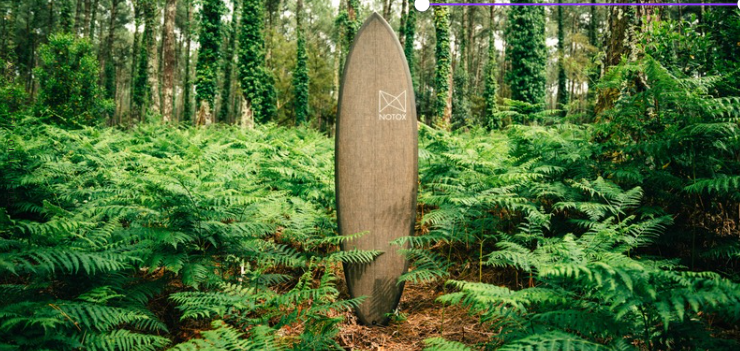
Pierre Pomiers founded Notox to prove you could build surfboards that treat people and the planet better. His guiding principle is consistency. His story shows what a company can become when it puts mission first, ahead of profit alone. Responsible innovation and sheer persistence do the rest. At th
Pierre is the founder of Notox. He works with leaders and projects that want their actions to match their values. His job is to bring meaning, consistency, and clarity back into complex environments.
Iker: You did a complete about-face after a PhD in robotics. What drove you?
Pierre: I've always cared deeply about minimalism, nature, and consistency. I can't stand things that don't add up. I can't stand people damaging the place they live in. If we end up destroying everything, then what? Move to Mars and die there? In that search, everything came together in one object. The surfboard stood for a dream world, driven by an extravagant industry swimming in profits. At the same time, it came with problems nobody wanted to talk about. Cancer among the craftsmen. Waste you'd never accept in your own backyard. It was all there. Everything that was wrong, everything I wanted to fight.
Iker: Did being an outsider make change easier?
Pierre: When you start from scratch, you do what you want, the way you want. You don't answer to anyone. That's what lets you build a vision. If you try to change things from inside a big organization, you can get boxed in by habits, silos, and hierarchy.
Iker: The market wasn't ready. How do you hold on for twenty years, no matter what?
Pierre: Only through personal conviction, and a kind of fighting spirit about that conviction. Things that existed 20 years ago and still exist today shouldn't exist at all. It's unthinkable. The best thing you can do is show there's another way. Stick to it. Never move off your line. Show it can be done, that it works, that it can last. It's a bit like tilting at windmills. But the idea is universal. I don't see many people telling me they disagree.

Iker: And that clashes with financial performance.
Pierre: Think about it. Say you make big margins selling products that cause health and environmental problems. Then you're profiting from problems that society has to deal with and pay for. You're not even financially responsible for the damage you create. We need to flip that around.
Iker: One trap in eco-design is improving one step and making the whole thing worse. Do you have an example?
Pierre: Early on, I got interested in materials made from corn starch. Renewable, biodegradable. It sounded like a great idea. Then I started working with a team from the CNRS, France's national research center, in Grenoble. I learned the starch came from GMO crops. Ethically, using farmland meant to feed people to make materials was a problem. Worse, those polymers needed a plasticizer before you could process them. The researchers explained it to me. Since the material is sold as biodegradable, the plasticizer becomes something living things can absorb.
Traces had already turned up in carrots sold in Germany. So here was a material that was supposed to solve problems. And it could create even bigger ones by spreading microplastics through the food chain. This was 2008. Back then, nobody was even talking about microplastics. That's when I told myself: I'm going to have to follow this thread all the way.
You can't afford to cut corners. You have to see things through.
Iker: Airbus and Dior came looking for you. What makes it click?
Pierre: Consistency over time. For more than 16 years, we've done what we say, and only that. People know where we stand. With Airbus, we fought for over a year to sign an agreement. It let us buy their off-spec carbon fiber scrap, which was headed for landfill. We recovered about 13,000 square feet of material. That's three or four tennis courts. We turned it into boards. Dior was different. They were looking for a manufacturer that could meet their requirements with Made in France. It showed me something. Even companies with almost unlimited resources sometimes have internal constraints. Those constraints stop them from going as far as we can, simply because we're small. But my proudest moment? The day a college textbook showed up in the mail. It was for a two-year technical degree, and it had five pages on us, with exercises. I thought: this is close to the Holy Grail. We'd reached the point where our story is used to teach kids.

Iker: For you, a company has a political dimension.
Pierre: I've always seen it as almost more of a political role than anything else. Never just a vehicle for business and profit. Otherwise, go run gold mines or oil wells. You'll make money faster. If there's no mission, I don't see the point.
Iker: What advice would you give a young Pierre Pomiers who had the same wake-up call today?
Pierre: Do it, absolutely. But maybe be less radical at first. When you want to wipe out everything you can't stand anymore, you cut yourself off from the system too fast. You're not offering anything gradual, so people don't get time to adjust. Start from what already exists. Improve it step by step until you get it where you want. Be a little smoother at the beginning, but have a long-term plan.
Iker: Fifteen years from now, your grandchild asks you: “Grandpa, what did you do back then?”
Pierre: I tried to bring consistency where there wasn't any. That's it. That's what I'd tell them.

Rapid-Fire Questions
One word to describe the ocean?
Goodbye.
A material that still fascinates you?
Flax.
A book that changed how you think?
The Junior Woodchucks comics.
Your DIY side?
Make do with what you have, and never more than what you have.
Shaper or engineer?
Engineer.
The quality you admire most in a leader?
Consistency.
If you hadn't started Notox?
I'd be bored stiff behind a desk, wondering what future I have as a developer now that Claude Code does it all so well.
Surfing or passing it on?
Passing it on. Because you can always do that.
Key Takeaways
4 Key Takeaways from My Conversation with Pierre Pomiers
1. Turn outrage into a mission
- Notox was born from a shock. Pierre saw how surfboards were really made, and it was harmful to both the craftsmen and the environment.
- So Pierre Pomiers decided to reinvent this iconic object. He wanted it to live up to the respect for nature it's supposed to stand for.
2. Consistency as your business compass
- His whole journey is driven by one goal: making his beliefs, his products, and his real-world impact line up.
- For him, building a business means bringing meaning back where it's been lost. Even when that means going against the dominant business models.
3. Innovate by questioning every assumption
- Notox doesn't just swap out materials. The company examines its entire value chain, so it solves problems instead of just moving them somewhere else.
- That scientific and ethical rigor made Notox a benchmark in eco-design. It has attracted partners like Airbus and Dior, and it's now taught in college programs.
4. Business as an act of commitment
- Pierre sees a company as a lever for changing society, far more than a simple profit machine.
- His message to entrepreneurs is clear. Standing up for a vision takes persistence. But lasting change comes from consistency, from passing on what you know, and from proving another way is possible.
Originally published in French on Konxus Média ↗