 Iker Aguirre
A Conversation with Théo Leblanc: Leadership, Youth, and Responsible AI
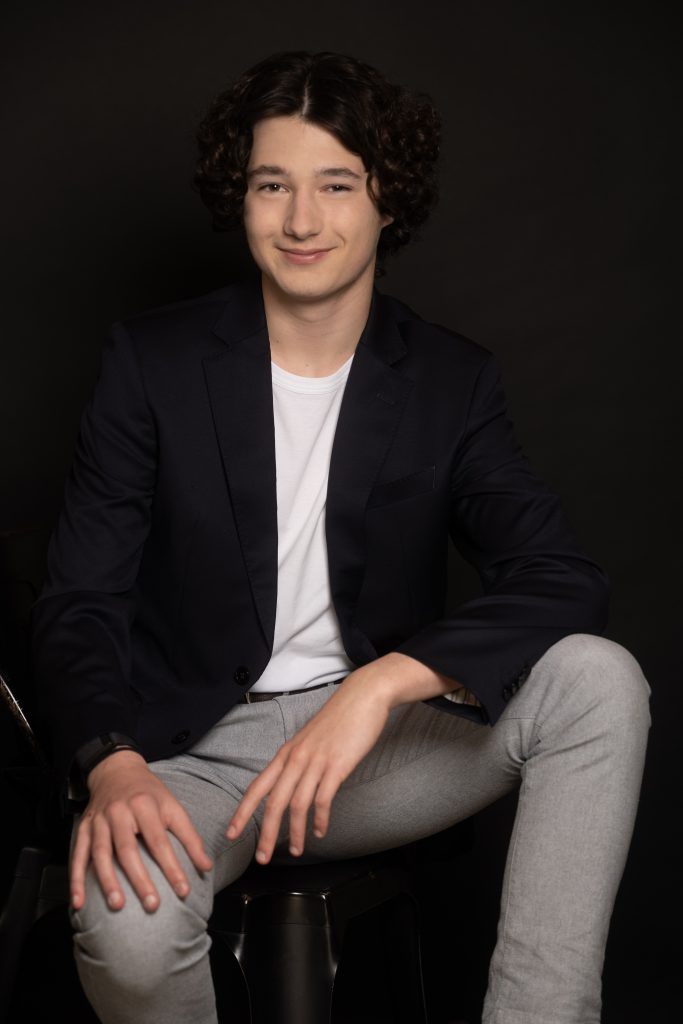
Théo Leblanc is 18. He's also a French entrepreneur, science communicator, and keynote speaker with a real following in artificial intelligence. In this joint interview with Iker Aguirre and Virginie Gonzalez, he lays out his vision for AI that is responsible, accessible, and meaningful. He tal
At 18, Théo Leblanc is already a French AI expert, a solutions developer, a science communicator, and a keynote speaker. Not bad for a start! In this joint interview with Iker Aguirre and Virginie Gonzalez, he opens up about what drives him.
Iker: How did you become so aware of what impact-driven leadership means? Was it instinct? Or did it grow out of the environment you were raised in?
Théo: My parents are entrepreneurs. At home, nothing was off-limits. We talked openly about money, and I got to try things from a young age. That opened my mind. I also went through some experiences as a kid that made me think a lot. I was pretty isolated, so I spent a lot of time in my own head. I wondered about death. About the meaning of life, and whether it had a point. How do you live a life you can be proud of? How do you contribute something? So part of it is innate. And part of it is the environment that let me develop it. I'd say it's a mix of both.
Iker: The moment you start asking “why?”, you're heading into big existential questions. Is that always on your mind? Or do you just go with it, and it feels natural?
Théo: My grandparents were astronomy researchers, so I have a special pull toward that. I love questions about massive scales. About universes that might be different from ours, with different laws of physics. The infinity of what's possible absolutely blows my mind. I love imagining every possibility, projecting myself forward, and pushing further.
Iker: You're carrying the torch for a rising generation that sees things in a completely new way. What do you stand for?
Théo: You can look at this new generation and see something amazing. All these young people doing things, getting ahead, making an impact. Breaking the rules and disrupting entire industries, even very traditional ones. Or you can look at the other side. A lot of young people are glued to social media. They struggle with addiction, they don't sleep enough, they eat poorly. So it's polarizing. Some people are doing more and more. Others are doing nothing, resting more and following less. The message I try to share is simple: move from passive to active. Do things, even if you don't do them well. Even if you don't do them as well or as much as you could. Just getting started makes all the difference. That's what I try to embody.
Iker: There are two big camps when it comes to AI. The boomers who tell us it's the end of the world. And on the other side, the enthusiasts who believe in progress. In business today, most people are still just trying to understand it. How can you help us get practical and concrete so we don't get left behind?
Théo: The truth is never black or white. It's usually gray. There's no universal answer. I'd love to find one, and I try every day. It means looking past the headlines and the big announcements. What are the real technological breakthroughs? What impact have they had? What impact will they have, or are they already having? There are real risks. One is that people won't be as useful at work anymore. A lot of execution work will end up being replaced. In a way, it's like past industrial revolutions. But it's scary, because AI looks like it could do almost anything in the coming years. What I try to do is help people navigate with a bit more vision. Instead of flying blind, you can at least see a few feet ahead. Even I can't see through the fog, unfortunately.
Iker: Do you see differences between industries? Places where the shift is more pronounced?
Théo: I see two main differences between industries. The first is how fast people adopt it. That usually tracks with the average age of the workforce, and with how close the industry is to tech. The second is how exciting the AI breakthroughs in that field look from the outside. Take medicine. It's one of the fields where AI is advancing the most. We're doing truly incredible things there. But it doesn't grab headlines. And yet the technological progress and the number of lives saved are mind-blowing.
Progress moves at roughly the same speed everywhere. When adoption is faster, it just feels faster. There's a ton of innovation happening in agriculture and construction. It simply takes longer to show up because it's less glamorous. Those workforces also tend to be older and less open to new technology. But every industry is affected.
Virginie: What you're describing is a wealth of competitive advantages opening up to anyone ready to seize them. Are we witnessing a whole new game? One that could completely redraw the market landscape?
Théo: It's a new industrial revolution. Except it's moving much faster, so it creates much more chaos. The people who manage to take advantage of it will be tomorrow's leaders in their industries. Because that's what all great leaders can do. They sense what's coming. They anticipate the changes so they can get there first. And in industries where people move slowly, whoever moves fast gains even more. It's not just AI, either. Robotics is coming. Transhumanism and quantum physics aren't that far off. The world is going to be completely transformed in the next few years. It's both terrifying and thrilling to live through. It creates a massive amount of chaos. And chaos means risk, but it also means opportunity. That's where you find the most interesting things.
Iker: So this raises a real question about identity, meaning, value, and uniqueness. What makes us unique as human beings compared to AI today? Where's the difference?
Théo: In my view, two things will gain value and won't be replaced by AI anytime soon. The first is simply the human element. Even if we have humanoid robots powered by AI, they're still humanoid robots powered by AI. Human connection won't be replaced, and every profession will lean into it more and more. The second is decision-making. We can't hand decision-making over to AI.
The reason is surprisingly simple. AI might actually be better at it than we are. But when something goes wrong, who's accountable? An AI can't be held responsible. So human decision-making will become more and more valuable. Especially in a world where whatever we decide can be carried out almost instantly thanks to AI.
Experts will always stay ahead of AI, because AI learns from them. If you're not one of them, and you don't have the ambition or the means to become one, you need to find another path. That could be human connection. It could be community. It could be finding what sets you apart and helps you stand out. Through your humanity, through your personality, through a distinct angle, because you bring something extra. That takes some soul-searching. You have to ask yourself where you can make a difference, and where you actually want to. Because sometimes you don't want to stand out. Everyone has to do that work for themselves.
Iker: And consciousness? Where does it fit in your view?
Théo: Consciousness is a tricky topic in AI. Several terms overlap, and people often mix them up.
A world model is an AI that could understand and act the way a human does. It would take in information through the same senses: sight, hearing, touch, all of them. It would be able to act and make decisions in the real world, doing as many things as a human can, just as well. We're far from that right now. But it's the main direction the big AI companies are focused on today. And it doesn't mean consciousness, or humans being fully replaced.
AGI means artificial general intelligence. An all-powerful AI that could do anything just by reading about it. We're very far from that. On the technical side alone, we have no idea what kind of breakthrough it would take. And even if we built it, we couldn't run it. It's not even a real question for another 10 or 15 years, maybe longer.
The singularity is the point where AI can improve itself on its own and drive progress without us. In theory, research would then accelerate exponentially. We'd lose some control. We'd no longer be the most intelligent species on Earth. That's a scary prospect. We're a bit behind schedule, but we're not that far off anymore.
Then there's consciousness, which sits somewhere in the middle, roughly at the level of AGI. I think the fear around it is misplaced, because it's not really the relevant question. We don't understand consciousness. We don't know where it comes from. The human brain is neurons connecting through electrical signals. We know which areas light up when we feel certain emotions or take certain actions. But that doesn't mean we understand consciousness.
So we have no idea how we'd create it. When you look closely, what AI does is purely prediction. We can't even picture what innovations might get us there. And fundamentally, companies have no incentive to build conscious AI. It could make it less efficient. We might end up with robots going on strike, AI going on strike. So to me, it's a false danger.
Iker: How should companies respond? What's our responsibility? How can we respond to this? And what's going to happen to society?
Théo: I don't think it's the company's responsibility. It's better if they educate people and explain what's happening. But I think it's still up to each individual. You could argue it's the job of public institutions. But then it comes down to what each of us believes those institutions should do. We still need to figure that out.
Every industrial revolution wiped out or replaced a huge number of jobs. And that led to massive job creation. The agricultural revolution created the service sector, because 90% of people suddenly had no work. The internet created an entirely new sector, a huge part of our economy that we couldn't live without today. What will AI bring? What will robotics bring? Maybe a lot of work centered on people. Maybe spirituality. I don't know. It's very hard to predict. But I'm almost certain it will open up a new field. I don't believe we're heading for some apocalypse where nobody does anything and we all live off AI and universal basic income.
Virginie: What role do dreams play in your life and your journey? Do they help you reconnect with meaning?
Théo: It depends on what you mean by dreams. If you mean utopian dreams you don't think can come true, very little. Maybe 5%. But if you mean huge goals that are hard and take years to reach, but fascinating, whether for the journey or the destination... That's 95%. That's the rest of my daily life, and everything points toward it. I do enjoy the journey, and I stay in the present too. But these goals make me dream. They fire me up when I think about what I could achieve at 30, at 40, and beyond. The impact I could have. All the things I could do that aren't within reach yet. That dream is most of my day-to-day right now.
Iker: Back to AI. At the end of the day, are we really talking about meaning? Aren't we at risk of being taken in by brilliant storytellers who sell us a world that doesn't exist?
Théo: There's an AI bubble, and you have to be aware of it. Some of today's valuations are absurd. That said, look at the technology we're using right now. For months, people have been saying 2025 will be the year of agents. That's the next step, where AI can take action instead of just producing text. For example, instead of asking, “What do I need to do to book a flight to Rome in three days at this time?”, you say, “Book me a flight to Rome in three days at this time.” And it does it. That's where things are heading. But timing in AI is tricky. Even the people building AI today don't know if their technology will be the final one. Innovation moves forward in small steps. So yes, there's a bubble. Yes, some companies are overvalued. No, LLMs (large language models) aren't the final stage. Maybe they're one step toward it. Still, cracking language is a very big deal. That doesn't make it a scam. It doesn't make it magic either. It's somewhere in between. It's usually gray. Never black or white.
Iker: It's a pretty complicated path. There's so much information out there. What advice would you give people like me who still need to figure out where they stand?
Théo: Just subscribe to my newsletter, FFREEA. It's there to help you understand AI, use it every day, and see how it's changing the world.
Virginie: When we talked about what you see yourself doing in 10 or 20 years, you mentioned you'd love to write a saga. If you wrote a book, tomorrow or in 10 years, would you write it with AI?
Théo: No, because I wouldn't have the same passion for it. What fascinates me and what I enjoy is the creative process. Building the world. I love creating fictional universes, imagining all their parts and how they connect. I wouldn't treat it as a business, trying to write the best possible book for the biggest possible audience. It's more of a fun hobby. So I wouldn't use AI. Maybe to enrich it, that could be interesting. To flesh out details of the world. But that's it.
Iker: Does storytelling have a special kind of power? Could we come to realize that our life experience has value that AI will never replace?
Théo: For me, that's exactly what the soul-searching is about. Look at what you've lived through and ask yourself some questions. What could you do all day without getting tired, and still enjoy it? What are you naturally good at? Where do you have that extra something? The combination of all that creates an identity. It's what makes a person unique, as a whole. Storytelling is simply the ability to share parts of that identity, so people can relate to it.
The next step is talking about it. Letting yourself shine. Depending on your goals, you don't necessarily need to create content or reach a big audience. You just need to know how to introduce yourself and show who you are. But the most important step is knowing yourself. That's how people get to discover what makes you different. They won't figure out who you are if you don't know it yourself.
Thank you, Théo!
Key takeaways
In this joint interview led by Iker Aguirre and Virginie Gonzalez, 18-year-old French AI expert Théo Leblanc opens up about:
- what drives him
- the disruptive message of his generation
- AI and what it will change
- AI and the question of identity
- AI and the idea of consciousness
- his dreams
Originally published in French on Konxus Média ↗