 Iker Aguirre
Two Paths to Putting People Back at the Heart of Your Company
Putting people back at the heart of your company opens up huge possibilities. But if you only focus on the dynamics, you'll miss the bigger process. […]
Putting people back at the heart of your company opens up huge possibilities. But if you only focus on the dynamics, you'll miss the bigger process.
The dynamics are the things you do to put people back at the center. The process is the set of major stages people go through along the way. The two are connected. But they are very different things.
Thinking only in terms of dynamics is like biking across the country with your eyes glued to your front wheel. Sooner or later, you'll make it. But you'll have to stop again and again to ask for directions and figure out where you are. It's a slow, zigzagging ride.
Thinking in terms of process means rising above the road. It means finding the common thread that runs through every dynamic. And that thread does exist. Finding it takes serious study and analysis. You have to take in a lot of examples, and just as many counterexamples.
This article is about process. It lays out two paths you'll travel, no matter which dynamics you choose to put people back at the heart of your company.
The first is an inner, individual path: growing as a leader. The second is a collective path: growing as a group of people who share a common goal.
Each path moves forward in stages. We'll cover:
- each of the two paths,
- the core work to do on each one.
That way, you'll always know where you are on the journey. You can also use it to assess how mature your leadership and your teams really are.
Conscious, Responsible Leadership: Understanding Your Many Impacts on People and the Organization
A leader guides a group of people toward a result. How aware that leader is determines how many dimensions show up on their scorecard. At the bottom of the ladder, the scorecard is purely financial. It ignores every other impact the business has.
The economic and financial side is essential. Without it, the company doesn't survive. Putting people back at the heart of your company doesn't mean forgetting its financial health! It simply means looking further ahead, and acting more responsibly.
Beyond the economic dimension, many others open up to you: the human, the social, the societal, and the environmental. Together, this is often called overall performance, or the triple bottom line. I've chosen to separate the human dimension from the social one, because it fits the two paths described here.
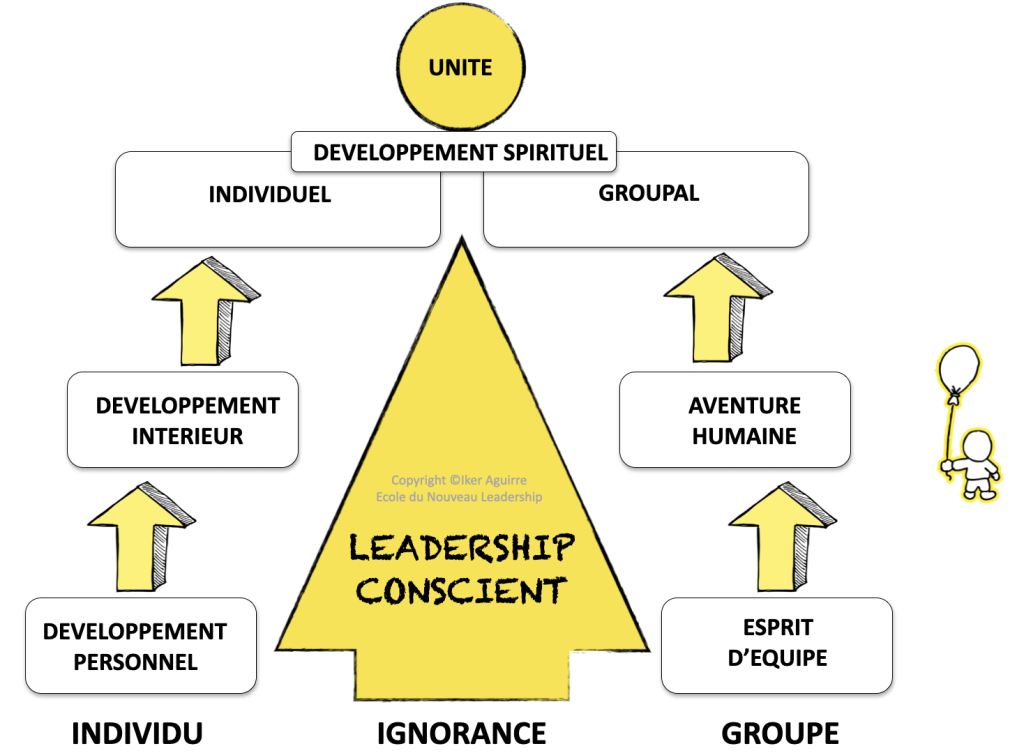
People at the Heart of the Company: Understanding the Two Paths of Transformation
Putting people back at the heart of your company is a demanding goal for any leader. You can't get there without understanding people inside and out.
That's why every leader who wants to meet this challenge has to travel two paths at the same time.
The first path is your own personal journey. It's an inner adventure. It leads you to wake up to who you are, to your potential, and to your rightful place in the world. It's an individual path, and it's non-negotiable if you want to excel on the second one. This is the “path of I.”
The second path takes a group down a road toward a shared goal. It energizes people within a community and helps them grow together as a group. This is the “path of We.”
The Path of I: Putting People at the Heart of Your Company Through Personal Growth
This is where the adventure begins.
It starts the moment you begin asking questions about yourself. The moment you want to know yourself and grow. The leader steps out of the fog of not knowing who they are. They stop just enduring life. They stop forcing their way through when things don't go their way.
The first stage is personal development. It's about discovering who you really are. At this point, you look at what shaped you: your story, your journey, your beliefs, your patterns, your strengths, your vulnerabilities. This is the realm of personality. The goal is to know and understand yourself so you can grow.
Here, you'll come across personality frameworks and self-reflection methods. Some of the best known are the Enneagram, Transactional Analysis, the Process Communication Model, DISC, and the MBTI. There are others, of course. This stage holds up a mirror. You learn to look at your reflection, both the bright side and the dark side. Then you work on strengthening the bright side: your gifts and your potential. And you shine a light on the shadows: your vulnerabilities, your limiting beliefs, and so on.
Beyond these personal development methods, you may also choose to go into therapy. It can free you from the psychological patterns that work against you.
The second stage is inner development. As you move forward in personal development, you build a bridge. That bridge leads to the potential lying dormant inside you. This is a new stage. Awakening human potential doesn't depend on personal development. You don't need to know your Enneagram type or MBTI profile to build, say, your charisma or your emotional intelligence. It helps, sure. But it isn't essential.

Human potential is the same for every human being. Gender, pronouns, background, culture, faith, age, and personality don't change that. Everyone starts on a level playing field. To awaken a given potential, everyone does the same thing, the same way. Results will vary from person to person, of course. But they'll show up, and they'll show up the same way every time. Your personality shapes how you use that potential. That's a different question. Using your potential is not the same as awakening it.
As you move forward in inner development, or awakening your potential, you'll naturally build bridges to the third stage: spiritual development.
Sooner or later, you'll start asking questions about your purpose and your place in the world. That's your first step into spiritual development. As you grow on the inner path, you'll be amazed at how deep your potential runs. Time and again, you'll feel a sense of wonder. You'll sense that there's something inside you and around you that's far bigger than you. That “something” goes by many names. Discovering it is what spiritual development is all about. And that discovery fits every worldview, from the atheist to the devout believer, and everything in between.

The Path of We: The Collective Road to Putting People at the Heart of Your Company
As a leader, you can't succeed on this path without understanding people. And the only way to understand people is to understand yourself. In other words, you have to commit fully to the first path.
With that experience behind you, you'll understand the challenges facing the people you work with. You'll be better equipped to help them rise, grow, and thrive on the way to your shared goals. You'll also have the humility and empathy to understand how hard certain stages of personal, inner, or spiritual development can be.
The path of We also starts with not knowing. Groups form and fall apart as the days go by. Sometimes it works. Sometimes it doesn't. It's pure luck. At best, it's a roll of the dice. At worst, it's Russian roulette, and you've handed the gun to your teams. Meanwhile, group dynamics strengthen or unravel on their own. And all the attention goes to technical skills.
Once you understand this, your first stage is building team spirit. The key is to move beyond a mere collection of people. That's a group that meets because it has to, with no emotional connection to the work or to each other. It's every manager's nightmare. Team spirit creates a sense of belonging, of standing out, and of achieving together. A shared identity emerges. A community is born, and it grows stronger.
For a long time, team spirit was seen as the Holy Grail of management. But it's only the first stage. Next comes the human adventure. It begins when the group helps its members thrive, beyond the shared goals. At that point, everyone realizes how much the group matters in their life. Powerful, unbreakable bonds form. Often, they last forever. We've all lived through one of these intense shared adventures. Twenty, thirty, forty years later, you run into someone from those days. It feels like you saw them yesterday. And you instantly feel the strength of the bond between you. You love this person. What connects you goes far beyond the project or the organization you once worked for. Yet back then, that project or organization was your whole world: a company, a sports team, a school…
The human adventure naturally leads to a new awareness. You see the impact the group has on your lives, and on the lives of everything around you: people, animals, plants, the earth itself. Accepting that responsibility means committing to the group's spiritual development. At this stage, the two paths meet, merge, and lift each other up. When someone working on their own spiritual growth gets to share it with others, the adventure becomes almost ecstatic!
The secret to these three stages is a subtle blend of group dynamics and a deep understanding of people. It's surprising how poorly understood and poorly documented group dynamics still are. Today, most of what's been written comes down to:
- management techniques that are useful but often limited,
- hands-on practices, such as collective intelligence.
Both have a positive effect on group dynamics. But they're only tools serving a process. So what is that process?
We hope to give you the answer through Konxus Media.
The End of the Journey: When People Become the Real Engine of Your Company
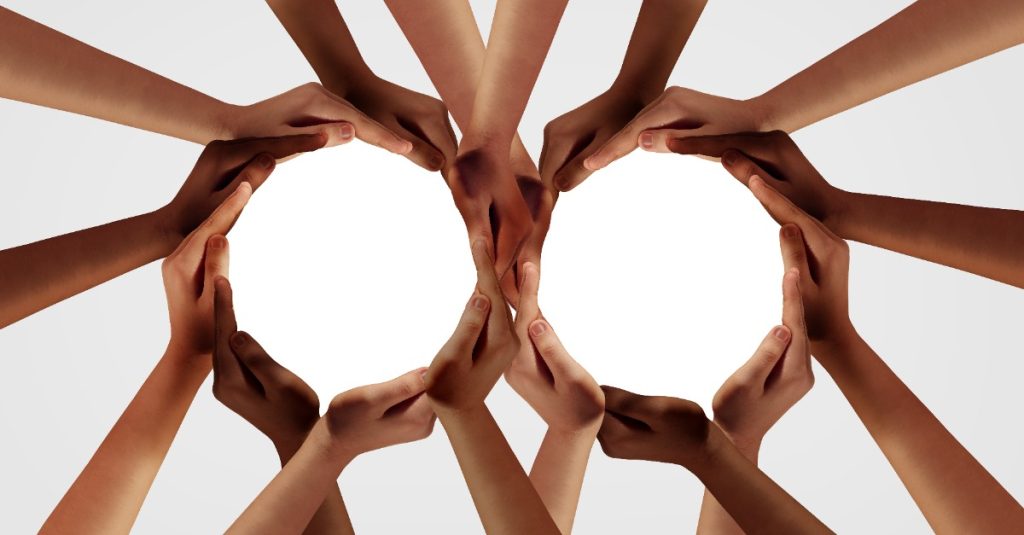
The end of the journey, shared by both paths, would be oneness.
I say “would” out of caution and humility. I've never experienced it myself, so I can only speak about it in theory.
My view rests on something every philosophy and belief system shares, whether modern, historical, or ancient.
Look at the great religions, modern philosophies, or ancient wisdom traditions, from the West, the East, or Indigenous cultures. Each one, in its own way, describes the same thing at the end of the spiritual journey: a state of ultimate awakening and union with the Whole. It's a state of oneness. Some call it God. Others call it the Tao, Wuji, Buddhahood, nature, the information field, or the Great Spirit, among many other names.
Let's be clear: nobody's reaching enlightenment through their job. Let's not get carried away. Still, we've all had flashes of oneness at some point in our lives. Those rare, magical moments when everything seems to fall into place. When you feel at one with all of life, whole, fulfilled, and joyful. A huge success. An extraordinary win. A once-in-a-lifetime love. A hardship you overcame together. Those are the moments when we can touch that state of grace.
The place where the two paths meet would be the start of a shared awakening. Picturing that happening inside a company feels like a sweet dream to me, at least given the times we live in and today's dominant corporate culture. And yet, experiencing moments of grace at work is within everyone's reach. If you're reading this, you've already had your share! Otherwise, you wouldn't care about articles like this one. Bringing together every path of I (each person is one) with the path of We, to share a moment of grace, however brief, is a challenge worth taking on.
Don't you think?
“They did not know it was impossible, so they did it.” – attributed to Mark Twain
Putting people back at the heart of the company looks like the alternative to today's dominant management model. That model is often called “mechanistic.” It sees the company as an engine that must run at full throttle, and people as its parts.
This approach leaves out a core part of what makes us human. That's the main reason it's hitting its limits today. Neglected and often mistreated, these human dimensions wear down. Eventually, they erode the company's most vital asset: the men and women who make it up. The result? Quality of work life plummets. Absenteeism soars. So does disengagement ([lien interne ARTICLE Rapport Gallup – désengagement des salariés]). And so does burnout.
The humanistic approach wants to put people back at the heart of the company. It sees people as whole human beings. And it does so without losing sight of financial health, or of social, societal, and environmental impact. It embraces complexity on purpose. It rejects the mechanistic dream of simple, one-size-fits-all standards. It's a paradigm shift for business.
Originally published in French on Konxus Média ↗