 Iker Aguirre
The Magical (and Scientific) Powers of a Good Hug
You have no idea how much good a great hug can do for your body. And that's true whether you give it or get it!
A lot of scientific research shows that a hug can truly change your day. It can change your well-being, too, and even the way you relate to life. So let's settle into a long embrace and look at that research, and at the main powers of a hug.
We'll lean on studies from major universities that confirm just how powerful a hug is. From that work, we'll explore the five big areas where hugs make a difference. Then we'll wrap up with what makes a hug ideal, and how to give one.
“Hold me in your arms. Time will stop, and life will go on.” — Iker Aguirre
Where the word “hug” comes from: a short history of the embrace
“Hug” is one of those short, warm words English does so well. And it has deep roots. Linguists usually trace it to the Old Norse “hugga,” meaning “to comfort.” Some also link it to old Germanic words tied to tenderness and embracing.
A hug has a special kind of power. Deep in our psyche, it works like a symbolic return to the safety of our mother's womb.
Virginia Satir, the American family therapist and author, put it this way:
“We need 4 hugs a day for survival. We need 8 hugs a day for maintenance. We need 12 hugs a day for growth.”
Sounds like a lot, right? Maybe even a bit over the top. BUT science backs her up!
Hugs put to the test: what studies on animals and humans show
Researcher Harry Harlow ran a famous set of experiments with monkeys. He separated baby monkeys from their mothers. Then he gave them two artificial mothers instead. One was made of soft cloth, like a monkey-shaped stuffed toy. The other was made of wire, but it gave milk.
Here's what happened. The babies stayed with the cloth mother. They only went to the wire one to feed.
Scientists who worked on Harlow's research went on to show that the same thing holds true for humans.
In fact, an object can ease stress, anxiety, and fear, much like the presence of someone you love. So even if you think you've outgrown it, go dig your old teddy bear or favorite stuffed animal out of the closet!

Why does a hug do so much good for your body and mind?
The University of Pittsburgh has run some fascinating studies on this. Its researchers showed that hugging someone lowers your stress for the rest of the day.
People who got hugs were less affected by tension and interpersonal conflict. That held true regardless of gender or setting: family, romance, friendship, and so on. They also felt safer.
Another study, from Wichita State University and the Kansas Heart Hospital, found that people who were hugged were less sensitive to pain. The study followed patients with fibromyalgia who were treated with touch.
Over the course of their care, these patients saw their quality of life rise sharply. Their pain dropped remarkably.
Among these researchers, Michael Murphy of the University of Pittsburgh showed that touch switches off the part of the brain that responds to threats. In other words, physical contact means your body releases fewer stress hormones when danger signals show up.
You know the “magic kiss” or “magic hug” when someone you love gets hurt? Science now says it's real!

- Hugs boost your oxytocin
Professor Murphy also showed that hugs raise your oxytocin levels. Oxytocin is a hormone released by the pituitary gland. It relaxes you and eases anxiety. On top of that, it blurs short-term memory! That's one more scientific reason a “magic hug” works when a child gets hurt.
No wonder oxytocin is nicknamed the “feel-good hormone” and the “cuddle hormone”!
- Hugs boost your endogenous opioid system
This series of studies on hugs and stress doesn't stop there. After oxytocin, a hug also gives a lift to your endogenous opioid system.
So what is the endogenous opioid system? It's your body's natural calming system. It helps you feel calmer and safer. It also softens your knee-jerk reactions to threats, like running, fighting, or freezing. The result: you're fully present, right here, right now.
- Hugs lower norepinephrine and cortisol
If you've listened to the episode or read the article on cold exposure, you've already heard about norepinephrine and cortisol. If not, you can catch up with episode 43 of the podcast Une Alchimie de l'Éveil (in French).
Between a good cold shower and a good hug, stress doesn't stand a chance!
- How hugs benefit children's health
Science has confirmed that a parent's magic hug really works. Now let's look at what hugs do for a child's health over the long run.
A study from the University of California and the University of Pittsburgh found that children who get affectionate hugs have fewer physical and mental health problems as adults.
The researchers looked at a group of adults. Those who reported a hard childhood, marked by abuse, violence, or loneliness, had more health problems. The adults who received lots of affection as kids fared better. And in the US, statistics suggest that 1 in 4 children goes through a hard childhood.

- Hugs strengthen your immune system
Another University of Pittsburgh study found that people who give and receive hugs regularly have stronger immune systems! They feel backed and supported by the people around them. And they report fewer serious illnesses.
The likely reason? Hugs make you feel safer. So your stress levels drop, and your immune system reacts less violently to threats. That matters. When your immune system overreacts, it can damage parts of your body and raise your risk of a range of diseases.
- Hugs lower your heart rate and blood pressure
A hug touches your heart, in every sense of the word! A study from the University of North Carolina showed that hugs lower your heart rate and blood pressure.
The study involved 59 women and their partners. After a 20-second hug, the women's blood pressure was lower when they described a romantic memory than when they faced stressful situations.
The same research team showed that hugs are good for heart health. Couples who held hands for 10 minutes, then hugged for 20 seconds, saw their heart rate and blood pressure go down. So keep it simple. Next time you go for a walk with your partner, hold their hand. Then pull them in for a hug. A hug is a key that opens the heart.
- Hugs ease depression
At a nursing home in New York, a program called “Embraceable You” was created to encourage touch between residents and staff. The goal was to improve residents' well-being and quality of life.
It turned out that residents who got 3 or more hugs a day were:
- less depressed
- more energetic
- better able to focus
- sleeping better
To confirm these findings and go further, the program was rolled out in 172 nursing homes in Sweden. The results were clear. Every resident who received hugs or other affectionate touch was:
- more connected to friends and visitors
- more socially active
- more likely to thrive!
Because love speaks in the silence of an embrace.

In fact, many studies show that isolation makes illness worse. It also lowers survival rates among older adults and people with serious illnesses.
The number of people living alone tripled between 1985 and 2004. And isolation raises the odds of feeling in poor health by 50%. It pulls you into a negative mental spiral, with real damage to your health.
- A hug after a conflict helps your mood and stress
Once again, we owe this finding to researchers at the University of Pittsburgh. People who get a hug after a conflict are less likely to feel stressed or see their mood take a hit.
A hug is a language all its own. It comforts, and it tells you someone is there with you. Another study found that hugs give people a feeling of social support.
Hugs easily create an upward spiral. Once you've hugged, you tend to start a whole new cycle of hugs. Hugs lead to more hugs! Over time, participants in one study were far more likely to get hugs (68% of days) than to experience conflict (7% of days).
How to give the perfect hug: a practical guide
First things first: respect the other person. Some people only hug in private. Others can't stand physical contact. And others will welcome you with open arms, but only if you respect their space and their comfort zone.
Ignore these basic rules, and a hug becomes a gamble. It can leave you with regrets just as easily as good memories.
Once you have the other person's green light, the scientific consensus says the ideal hug lasts 20 seconds. That's how long it takes to get all the benefits we've talked about.
That said, some say 6 seconds is enough! Find the sweet spot that works for you. A hug works when you put your heart into it. The first essential step is to connect fully with the person in front of you, with all five senses.
Our second tip: be fully present, in the moment and in the gesture. A hug offers your presence to the other person. It's a gift of who you are. It says, “I'm with you, body and soul.”
A hug reaches its full power when your heart opens and your energy flows. An empty gesture won't have the same effect. It turns into a polite, going-through-the-motions hug. And that feels more awkward than inviting.
“A hug changes two lives: the one who gives it and the one who receives it.” — Iker Aguirre

You could call it an embrace, a cuddle, or a squeeze. But “hug” is the word everyone reaches for. And it got a big boost about a decade ago, when a video went viral on YouTube (seen by more than 78 million people!).
It showed a friendly guy walking the streets with a sign that read “Free Hugs.” The footage was deeply touching and human. It moved millions of people around the world. And just like that, “free hugs” became part of everyday language.
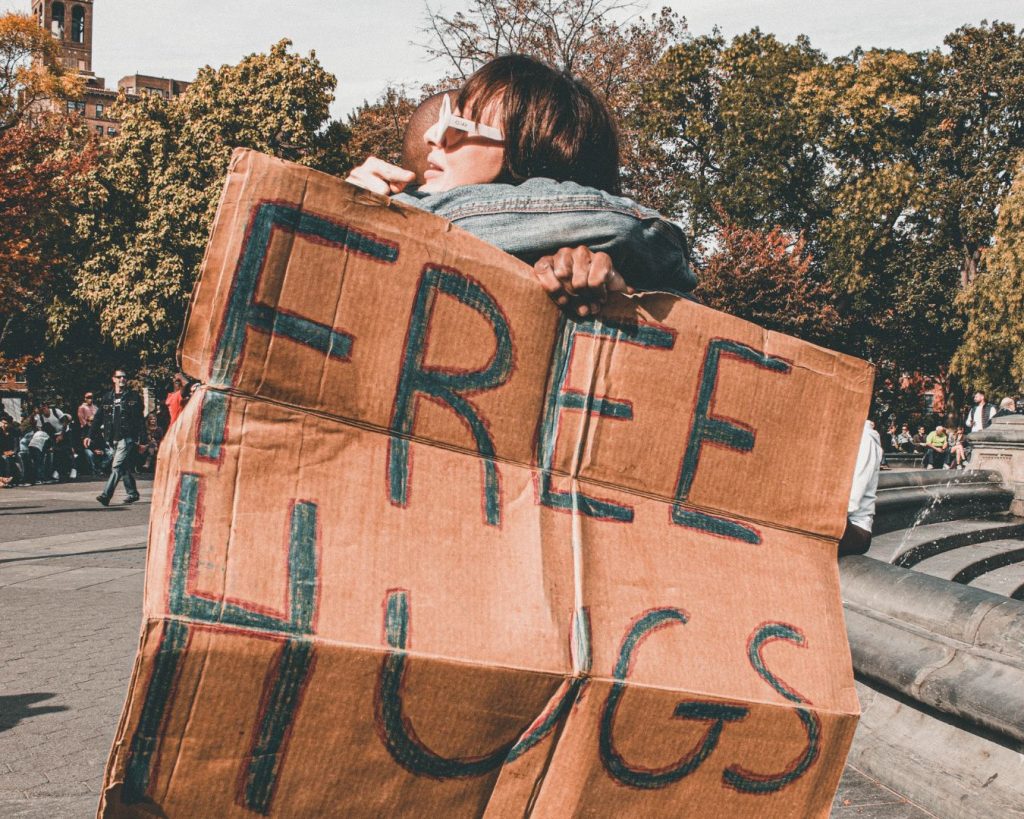
But did you know the word itself has Germanic and Norse roots?
Think of the Teutons, a Germanic people from northern Europe. Along with their neighbors, they gave the Roman legions serious trouble. Rome called them “barbarians.”
So naturally, you picture big brutes in animal skins, swinging 100-pound axes. Who would've guessed that this rough crowd, and their Viking cousins, would give us such a gentle word? The words behind “hug” meant “to comfort,” “to be tender,” and “to embrace.”
Turns out those barbarians were big softies after all!
Originally published in French on Konxus Média ↗